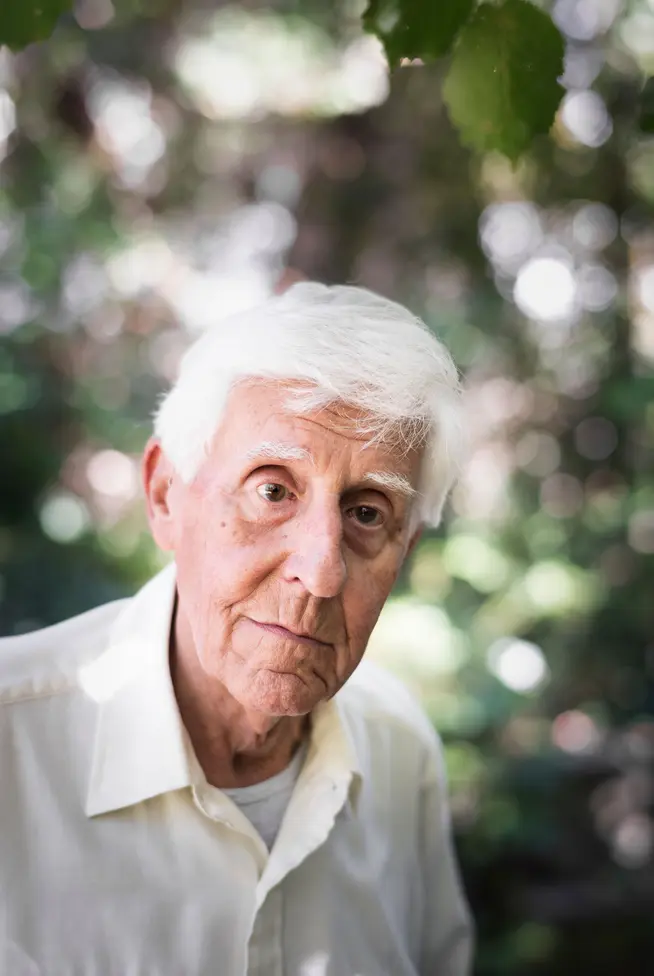
Peter von Matt (20 May 1937 – 21 April 2025)
Dear English-Speaking Friends.
Peter von Matt was a Swiss literary scholar, author, and essayist. He died last week.
I only met him once. He gave a speech, on the 60th birthday of one of my professors at the time, about what makes historical research and writing a worthwhile endeavour. About what makes a great historian and a great writer.
I was 19 years old, had just started a history degree, and I wasn’t entirely sure why I liked it so much.
In classic teenager fashion, I found this uncertainty very alarming and frantically looked for answers. To write clear, true things, I thought, historians needed to be objective. And I associated this with the role of a precise and unfeeling robot: Find the facts. Write down the facts. Write down nothing else. Done. Good historians were, to me, basically advanced-archive-search engines. I thought a lot about bayesianism and reference classes and the meaning of the word “probability”. Because of this, the value of history seemed to entirely depend entirely on the purity of historical facts – which was worrying, because people around me kept treating the field a little bit like “story hour” and my professors kept talking about a “creative challenge.” I kept harassing these professors with questions and arguments about the epistemic purity of historical science, how we can really be sure about the causal links between historical events (with no breaks on their 60th birthday), and it all didn’t help much. I had a vague sense of why history was useful, but that vague sense felt deeply unsatisfying.
Peter von Matt clarified that vague sense, and changed my mind about history and writing and many other things. By doing what he seems to be good at: Stating an argument clearly and intuitively enough that a “vague sense” crystallises into something tangible. Something you can argue clearly about. And something you can provide alternatives to.
The following is a brief summary, as well as I can remember.
Good Writing, Robots, and Cans of Worms.
Of course, both on an individual and collective level, we can kid ourselves into believing that, if we only decided to, historians could behave like robots. They could write chronologies and do a statistical analysis of every single source there is. There are a few problems with this. Firstly, history lacks randomised control trials. Establishing anything like “empirically proven” cause and effect quickly becomes difficult. Secondly, History is chaotic. Thirdly, we have limited information. Archives are not, in-fact, time-machines. So writing robot history is hard.
But then there’s another question: How should we decide what chronologies to outline? Which questions should the robots ask?
Our decisions, as individuals and societies, on what to write about, how to write about it, and what to do with the writing we already have, are influenced by the most non-robot things: Our deepest, darkest wishes and fears, our misconceptions and insecurities – which often have a long history. Whether we open a can of worms or not – the worms are there. And pretending otherwise will not magically turn us into a precise robot scientist. Our past and present wishes and fears, our misconceptions and insecurities are still worms and our brains, our cultural and political institutions, are full of them. The worms haunt us. And they will continue to muddle their way into our decisions, until we find a way to deal with them. It’s a scary idea.
Von Matt, as I remember, made the argument that the primary jobs of historians does not, in fact, have to be “robots about the past”. But opening these cans of worms.
They can do this, when they nurture a curious fascination for all the most shameful and irrational human tendencies, our ugly past, our ignorance, arrogance, forgetfulness, our hunger for power and frequent lazy resignation. Historians and writers can find these “worms”, in past, present and fictional lives, shed a warm light on these scary shameful things, and explain how even those parts can be understood, and thus understandable – and sometimes even funny. This shared processing helps with the blinding fear and destructive intimidation that makes avoidance so seductive. It makes it easier to face our individual and collective characteristics, the good and the bad ones, so we can decide what to change and what doesn’t need as much changing as we might have thought. It’s worth mentioning – as von Matt did – that this process requires us to be exactly what robots aren’t – genuinely empathetic. There isn’t one “true” way to do this, any more than there is a “true” way to be a good friend.
And then, when we admit to ourselves that we indeed aren’t robots, when we find a way to deal with the worms, we can make better decisions about what to do with the time we have left.
I wish I could tell Peter von Matt that I often think about that speech, and that I’m continuously saddened by the fact that I didn’t take better notes. At the time, I mostly felt comforted that someone almost four times my age knew some of my inner fears about history, and thinking in general, better than I did, and gave me an honest answer to a question that seemed important to me. Afterwards, I realised how much it meant to me that the speech aimed to encourage and advise, when it could have been just as useful an instrument for cutting criticism.
Following Your Own Advice, Writing Your Own Obituary
When I started writing this, I thought that only pointing to the one speech that I happened to be around for would be a gross oversimplification of who Peter von Matt really was. I didn’t even know him that well.
I thought that I needed to write in detail about how he didn’t seem to approximate clarity by hedging his claims into irrelevance, and instead seemed at peace with himself, knowing exactly what he wanted to say. How he wrote a whole book about machiavellian conspiracies, and difficult childhoods, and how he didn’t shy away from the ugly parts of human brains and the cruel past they emerged from. How he was funny and kind and profoundly empathetic about these difficult things, and that he could veer into touchy subjects like “why should you or shouldn’t you study the subject you already signed up for” or “why does this country exist, anyway?” without seeming invasive, bitter, mean or naive. How much it meant that he used his powerful writing ability for something good.
It really shouldn’t have taken me this long to realise, but, of course, Peter von Matt already said everything I wanted to write about him here, in the speech he gave five years ago, about the shape and value of great writing. Because he actually walked the walk. The thought of following your own advice so well that your advice ends up making up most of the obituary someone writes about you is a bit morbid to me. I have a sense, though, that this is the exact kind of thing Peter von Matt would have been amused by.
Translations
Peter von Matt wrote many things. Some of them are public on the internet. They are in german though. For my English speaking friends, I got ChatGPT to make a translation of two speeches, which are obviously worse than the original, but – I’d argue – much better than nothing.
A speech about history, collective memory and its influence on political culture – and how we don’t just need to look back, but need to do something with what we find when we do.
He gave the speech on the 200 year anniversary of the “Helvetik” – Napoleon’s invasion of what were then a few cantons who really didn’t like each other much and the construction of the first Swiss nation state. For citizens of any polarised society, I think this is especially worth reading.
A speech given on the first of August 2009, the swiss national holiday, on the “Rütli” – a meadow in the middle of the country, which holds somewhat of a mythical status in Switzerland. Every year, someone gives a speech there – usually a government official. Peter von Matt spoke about Europe, peace, technological progress and the responsibility of a historically uniquely free people.
My favorite quote, which is sadly very timely, is the following:
“Switzerland is our homeland. But the homeland of Switzerland is Europe —
this Europe whose great powers have not fought a war against each other for more than half a century. That has never happened before in history. We are the first people privileged to witness it. It is a greater achievement than the building of the pyramids or the landing on the moon. Whoever does not understand that this peace is also our peace has a poor mind or a withered soul. “
 Lara Thurnherr
Leave a comment