1 What Is Courage?
I think many of us learn about the value of courage in fiction. Characters refuse to break their promises, give up, even in desperate situations. And then, we see David kill Goliath, and Hamilton and his friends “turn the world upside down”. Courageous people are, in these stories, always rewarded for doing what they think is right. There’s a useful lesson here. Situations are not always as hopeless as they might seem at first.
This lesson can protect us against a pessimistic kind of fatalism, by raising a series of important, uncomfortable questions: “Are you really sure that all is lost? That there’s “nothing you can do”? Are you really sure that it can’t possibly get any worse than this?” We might realise that our fears are not predicting the future, that they’re a memory of a worst case scenario we already experienced. Or we might realise that we’re scared because we care about something fragile. We might realise that we don’t want to abandon that care. Learning these things, admitting them, and acting accordingly, can make us happier. It can make us feel, literally, “encouraged” to act in our own interest, and it wont feel like a sacrifice.
Feeling encouraged and at peace with our decisions doesn’t, necessarily, make us look particularly brave to those around us. Conversely, looking brave doesn’t always end well – and it can be quite dangerous, I think, to pretend otherwise.
2 War and Punishing “Cowardly Conduct”
Militaries have claimed the ability to diagnose courage for centuries. With the authoritative confidence of someone who simply articulates obvious truths, military officials have spoken of “the courageous acts” of soldiers – and call on civilians to partake in commemorative rituals to “honor the courage” of “fallen heroes” : People who did their job, didn’t run away, and died because of it.
Military commemorations go further than providing an occasion for the collective grief of losing loved ones, or the tragedy of war. They also, very frequently, tell a (hi)story about how every soldier who died in battle was brave and good – that these qualities are what make them who they are now: a “fallen hero.” On grave stones, memorial statues and in speeches, the act of dying in battle is declared as a self-evident symptom of courage, an obvious form of self-actualisation. They provide a eulogy for past and current soldiers. Arguing with this eulogy feels distinctly impolite, inappropriate, tone deaf. Asking how anyone can actually be sure whether all soldiers died out of a sense of idealistic patriotism feels as “out of scope” as conversations about what happened to those soldiers who chose, voluntarily, not to self-actualise themselves to death.
During the First World War, the British government sentenced about 3,000 young men for the crime of “misbehaving before the enemy in such a manner as to show cowardice.” Here’s a summary of one of those sentences, Private Farr:
“At 9.00 am that morning (17th of September) Farr asked for permission to fall out, saying he was not well. He was sent to see the medical officer, who either found nothing wrong with him, or refused to see him because he had no physical injury – the Court Martial papers are unclear on this point. Later that night Farr was found still at the rear, and was again ordered to go to the trenches. He refused, telling Regimental Sergeant Major Hanking, that he ‘could not stand it’. Then Hanking replied ‘You are a fucking coward and you will go to the trenches. I give fuck all for my life and I give fuck all for yours and I’ll get you fucking well shot’. At 11.00 pm that night a final attempt was made to get Private Farr up to the front line, and he was escorted forward. A fracas broke out between Farr and his escorts, and this time they let him run away.”
Henry Farr was arrested the next morning, sentenced to death two weeks later, in a trial that – apparently – lasted less than an hour. He had joined the army when he was 17. Two years before the war started, he became the father of a little girl named Gertrude. He was shot at dawn when Gertrude was four, and he was 25 years old.
300 British men, 11% of those who were convicted, died for the same crime. I imagine many more died because they preferred the prospect of being fondly remembered as a hero to the prospect of dying a criminal.
A culture that celebrates courage as a virtue comforts us about someone else’s suffering by calling that suffering an intentional sacrifice. It allows us to see soldiers who suffer, or die in a war, as completely independent from their circumstances. It makes us forget about those who contributed to their suffering, started a war, or killed them. Giving up on blaming an evil foreign enemy for the loss of a loved one is a natural part of peace-building, and certainly helpful.
The ideal of courage though remains available to present and future Regimental Sergeant Major Hankings: People who punish those who fail at a convincing imitation of a fallen hero in waiting – or worse – choose not to try.
80 years after the death of Private Farr, he and his fellow convicts received a posthumous pardon. US martial law on “misbehaviour before the enemy” still reserves the death penalty for “any member of the armed forces who before or in the presence of the enemy is guilty of cowardly conduct.” (§899. Art. 99)
The word coward comes from the Old French coart. It literally means “one with a tail” or “one who turns tail.” They abandon their posts, run away, or are – just generally – “guilty of cowardly conduct”.
3 Goliath, a Coward
There is this poem called “Die Bürgschaft” by Friedrich Schiller. It’s a ballad, very long, and it starts a lot like one of these familiar underdog stories. A man (Damon) gets caught trying to kill a tyrant (Dionysius). The tyrant sentences Damon to death. But Damon’s sister is getting married, and needs her brother to walk her down the aisle. So Damon asks the tyrant for three final days of freedom, and offers his friend, Phintias, as a hostage. Dionysius agrees. In the english translation, it sounds like this:
The King then smiles with malice in his face, And speaks after thinking just briefly: “Three days I’ll give for your journey. But beware! If you’ve used up your days of grace, Before you’ve returned to me from that place Then he must to death be committed, But your sentence will be remitted.”
Damon, after a number of hurdles, makes it back right before the execution. The two friends, in tears, fall into each other’s arms.
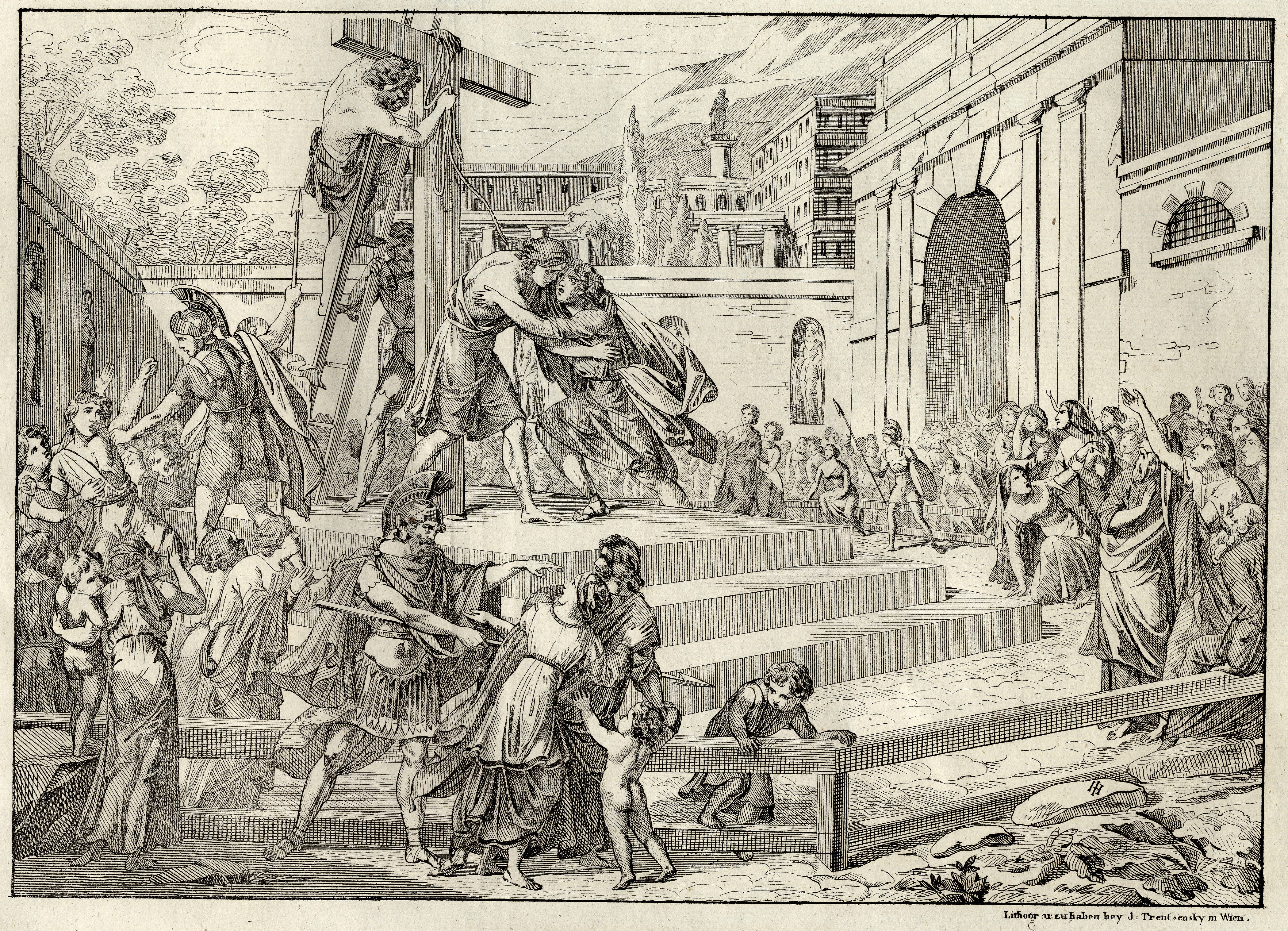
Thinking of classic tales of tyrants and underdogs, we might expect the story to end with Damon and his friend killing Dionysius, or inspiring a revolt. The glorification of Damon and Phintias, as couragous heroes, can make it seem like Dionysius needs to die or fail in some humiliating way. But that’s not what happens. Dionysius orders the two friends in front of his throne:
“And long he regards them with wondering eye, Then he speaks: ‘You have prospered, This heart of mine you’ve conquered, And honest trust, ‘tis no empty vanity, So into your friendship’s bond take me, I would, if allowed my intention, Become the third in your union.’”
I like the poem.
I think it’s a perfect example of Montaigne’s point that “Fear gives a final demonstration of its power when, for its own benefit, it gives us back all the courage it stole from our duty and our honour.”
Dionysius, in some ways, fails. He’s forced to admit that friends do, in fact, exist. And that he’s alone. His fear of continued loneliness steals the courage he needs to do his tyrannical duty, and honor his cynical promise of executing Damon. It also forces him to take a risk: How safe will he be, if he forgives someone who tried to kill him?
But that same fear gives him back the courage to explain why he acted like that in the first place, and to ask for forgiveness and friendship. I like the poem, because everyone lives, as a direct consequence of the decision of a character who might not be particularly heroic, but understandable, if not endearing, nonetheless.
4 Courage, Cowardice And Care
David, the “brave shepherd”, gives us a simple solution to the question whether “the ends will justify the means”: Checking. David just goes ahead, with whatever means he has. After he successfully decapitates the Giant, the story ends, and readers are encouraged to assume that Goliath deserved to die. It’s not surprising then, that celebrating the sacrifice of soldiers as a virtuous act of courage can make it difficult to ask questions about whether such a sacrifice was really necessary in the first place.
It’s important though, because real life, or history for that matter, doesn’t “end” as conveniently as stories do. Tyrants have been decapitated before. Afterwards, the curtains stubbornly refuse to fall.
A healthy appreciation of cowards and cowardice can protect us from another, more subtle kind of optimistic fatalism. It can raise a series of different questions: “Are you really sure that the victory you’re fighting for is the victory you want? That it’ll redeem you for everything you plan to do, or abandon, until it arrives?” An honest answer to this question might be surprising at times. It can be easy to forget that victory, no matter how heroic, or glorious, or possible, won’t reward us for abandoning our lives, for example, or (however unpopular) that of a sworn enemy, that it won’t make us better than anyone else, or immune to regret. It can be confusing when at a party, someone calls our outfit “a brave choice”, and it doesn’t feel like a compliment. A healthy appreciation of cowards can make us understand why.
Acting accordingly can make us happier. It can also make us more honest. We might still decide to fight in a war, but unlike Regimental Sergeant Major Hanking, we’ll admit we care about our own lives, and won’t feel entitled to punish others for doing the same.
There’s something about the word cowardice that sounds sophisticated and authoritative. It sounds like a harsh, but legitimate legal term for a specific kind of crime. Maybe that’s just because it’s old and French. It would sound ridiculous, after all, if we’d charge people with the crime of “being a sissy.” We’d feel like children, teasing others for not joining in on a brawl, privately terrified of looking weak in front of our friends. Personally, I feel hopeful about the idea that people can grow out of that sort of thing.
 larathurnherr.blog
Leave a comment