I really don’t know anything about what makes a good poem a good poem. It feels a lot like asking “what makes a good sound.” But people make playlists of sounds that they like, and I think it should be at least as normal to make personalised anthologies. (Walter Benjamin apparently wanted to submit one as his PHD-thesis?) In that spirit, here are some notes on my favourite Auden Poems.
“September 1 1939” is an obvious one, and it’s not very cool to like the obvious one, but (I think) doing so anyway might be the point of the poem. It starts out so devastatingly cynical and it really makes the beautiful lines about “an affirming flame” at the end credibly authentic. If the poem started with the line “we must love one another or die”, I would like it a lot less, which is slightly humbling to notice, but in the same way that good writing often is: It feels like Auden knows that he has to prove that he really (no – really) understands how terrible things are in September 1939, until he can credibly talk about anything even tangentially affirming, and also that that’s childish. I’m not sure, but I like to think that this knowledge is what makes him good at writing about politics without doing so explicitly, and it makes lines like “There is no such thing as the State and no one exists alone.” feel so much more powerful. Another one of his poem where this ability comes through is his “musée des beaux arts”:
“About suffering they were never wrong,
The Old Masters: how well they understood
Its human position; how it takes place
While someone else is eating or opening a window or just walking dully along
How, when the aged are reverently, passionately waiting
For the miraculous birth, there always must be
Children who did not specially want it to happen, skating
On a pond at the edge of the wood:
They never forgot
That even the dreadful martyrdom must run its course
Anyhow in a corner, some untidy spot
Where the dogs go on with their doggy life and the torturer’s horse
Scratches its innocent behind on a tree.
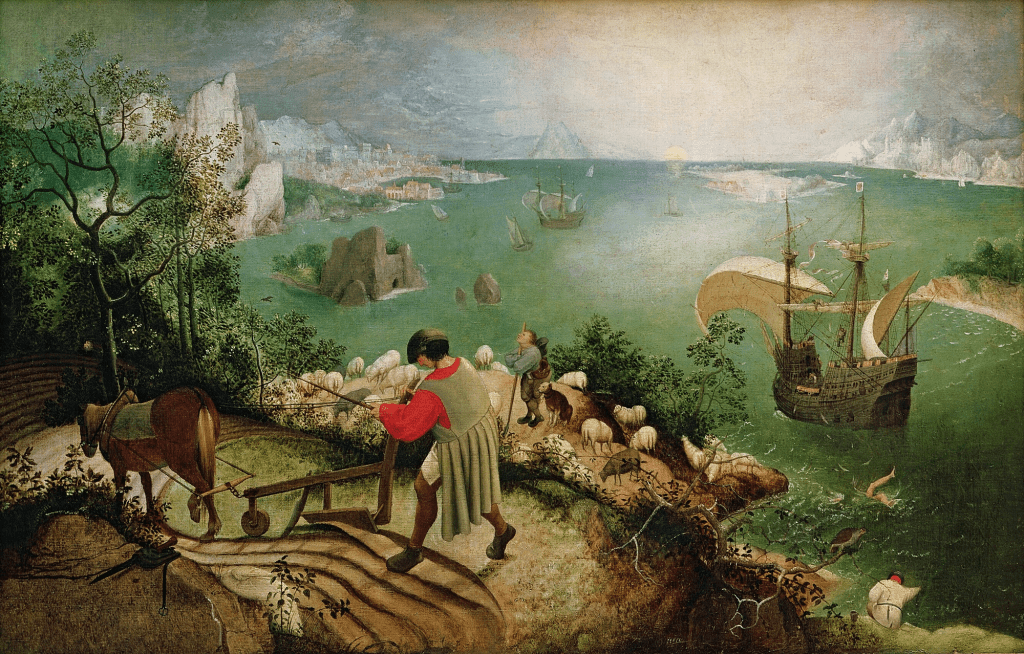
In Brueghel’s Icarus, for instance: how everything turns away
Quite leisurely from the disaster; the ploughman may
Have heard the splash, the forsaken cry,
But for him it was not an important failure; the sun shone
As it had to on the white legs disappearing into the green
Water; and the expensive delicate ship that must have seen
Something amazing, a boy falling out of the sky,
Had somewhere to get to and sailed calmly on.”
I like that the reader is left in the dark on whether Auden likes the ploughman or not. It’s unsettling.
Similarly unsettling are his descriptions of political ogres. In a short poem on the repression of the Prague Spring (“August 1968″) he writes:
The Ogre does what ogres can,
Deeds quite impossible for Man,
But one prize is beyond his reach,
The Ogre cannot master Speech:
About a subjugated plain,
Among its desperate and slain,
The Ogre stalks with hands on hips,
While drivel gushes from his lips.
But the ogre also comes up earlier, in “Letters to Lord Byron”, in 1937, answering the question:
Where is the John Bull of the good old days,
The swaggering bully with the clumsy jest?
His meaty neck has long been laid to rest,
His acres of self-confidence for sale;
He passed away at Ypres and Passchendaele.
He then writes, from the perspective of any aspiring “John Bull of the good old days”:
‘I am the ogre’s private secretary;
I’ve felt his stature and his powers, learned
To give his ogreship the raspberry
Only when his gigantic back is turned.
One day, who knows, I’ll do as I have yearned.
The short man, all his fingers on the door,
With repartee shall send him to the floor.’
He dreads the ogre, but he dreads yet more
Whose who conceivably might set him free,
Those the cartoonist has no time to draw.
Without his bondage he’d be all at sea;
The ogre need but shout ‘Security’,
To make this man, so lovable, so mild,
As madly cruel as a frightened child.
On a sidenote: He is also just very funny. Following the line “to give his ogreship the rasperry” he has this amazing stanza.
Suggestions have been made that the Teutonic
Führer-Prinzip would have appealed to you
As being the true heir to the Byronic—
In keeping with your social status too
(It has its English converts, fit and few),
That you would, hearing honest Oswald’s call,
Be gleichgeschaltet in the Albert Hall.
He comes back to the ogre though:
Against the ogre, dragon, what you will;
His many shapes and names all turn us pale,
For he’s immortal, and today he still
Swinges the horror of his scaly tail.
Sometimes he seems to sleep, but will not fail
In every age to rear up to defend
Each dying force of history to the end.
Banker or landlord, booking-clerk or Pope,
Whenever he’s lost faith in choice and thought,
When a man sees the future without hope,
Whenever he endorses Hobbes’ report
‘The life of man is nasty, brutish, short,’
The dragon rises from his garden border
And promises to set up law and order.
Forgive me for inflicting all this on you,
For asking you to hold the baby for us;
It’s easy to forget that where you’ve gone, you
May only want to chat with Set and Horus,
Bored to extinction with our earthly chorus:
Perhaps it sounds to you like a trunk-call,
Urgent, it seems, but quite inaudible.
And then the image of a wide open sea, that a ploughman might not have the time to look at.
We’re out at sea now, and I wish we weren’t;
The sea is rough, I don’t care if it’s blue;
I’d like to have a quick one, but I daren’t.
And I must interrupt this screed to you,
For I’ve some other little jobs to do;
I must write home or mother will be vexed,
So this must be continued in our next.
(It turns out that, like the ploughman, W H Auden doesn’t always have the time either).


Leave a Reply