In a widely cited blogpost called “How big a deal was the industrial revolution?” Luke Muehlhauser asks a rhetorical, but important, question:
what collection of events is that?
Leaving aside current disputes about what a “helpful” definition of the industrial revolution should be, below is a brief exploration of the origin of the phrase.
Raymond Williams wrote about it, in his book about “Keywords” of political discourse. He argues that, before Arnold Toynbee popularised the term in the 1860’s, it was first used “technically” in 1827, as a purely descriptive phrase for a rapid change in industrial processes, and it’s impact on broader society. To support his thesis, he cites a 1922 paper by Anna Bezanson called “the early use of the term “industrial revolution.” Bezanson writes:
“My interest in the origin of the term arose from reading the debates of the French Chamber of Deputies. Le Moniteur Universel of August 17, 1827 reprinted an article from the Journal des Artistes. In the center of the page in italics were the words “Grande Revolution Industrielle.”
I liked Raymond Williams book so much that I became a member of the Raymond Williams society. It has a great website, and I attended one of their annual lectures a few weeks ago. It was lovely. Still, there are two problems with Williams’ argument:
Firstly: The author of the 1827 article in the “Journal des artistes” is not using the image of a “great industrial revolution” to make a purely descriptive, “technical” point.
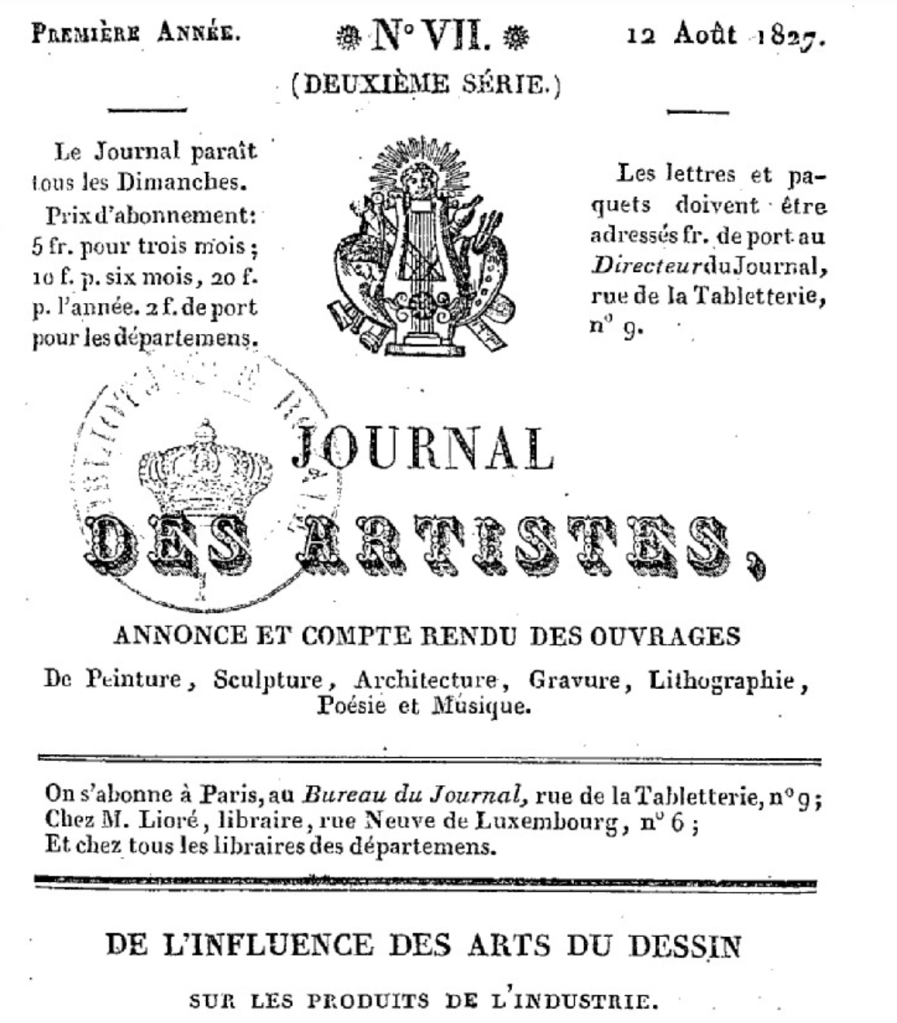
You can read it here. It criticises how industrialists (instead of artists) shape the aesthetic value of commonly used products – from mantlepieces to carriages. The author compares this state of affairs to the “celebrated age” of Louis XVI, when artists had more of the authority they deserved. In those good old days, the arts rose “abruptly to a higher degree of perfection”. They were “that governing principle which gives industry its rule and direction” . They “received their inspirations in silence and repose, far from the agitation of material interests.”
The reference to the “greatness” of this rising aesthetic influence of industrialists, the „grande revolution industrielle“ is likely a sarcastic reference to the “great” promises of the political revolutions of the previous century. (And not, as Williams seems to suggest, a phrase to describe the diffusion of the steam engine or the power loom.)
Apart from the the content, I think this interpretation becomes clear when reading some of the other articles in the same publication.
Sarcasm and sharp (but funny) stabs are everywhere: Reviewing a set of plaster statues of Christ and the four Evangelists placed in a church, the author writes: “These statues… but it is better not to speak of them. Why not have left these niches empty, which would at least have left us the pleasure of hope!”
The anti-revolutionary position of the journal also appears frequently: In July 1827 , when the journal reviewed the Musée Royal de France, it frames the revolutionary and Napoleonic periods as a time of losses that the restoration government had been working to repair: “after the losses of [the Revolution] and 1815, zealous and well-considered care has succeeded, if not in repairing all the damage, at least in repairing part of it and skilfully masking the rest.” (There is also some secondary literature on the publications political stance, e.g. Roth, 1989.)
The article itself is a part of the journal’s extended coverage of the industrial fair of 1827.1
It’s very critical of the fair and its attendees: The fair “ought to be a competition serving to establish the progress of each branch of industry, and not a fair where every manufacturer displays whatever he has that is most beautiful and best.”
I’m guessing few people will find it hard to believe that an artists-journal might not be overly impressed with industrial progress or industrialists. Some contemporary readers might find it implausible though, that the same Parisian artist would also be so cynical about the French revolution and its achievements. I think this makes sense. Parisian artists are often associated with bohemian progressivism and much of our collective memory of the French revolution revolves around romanticised les-misérables-esque heroism.
It’s common knowledge that terrible, unnecessary things happened in the name of this revolution, but we mostly talk about them in symbolic (Guillotines) or abstract ways (“The revolution eats its children”). So, to make the position more understandable, here are some concrete things that an arts critic from 1827 might associate with the the French revolution.
The first French industry fair was planned in 1798. The Minister of the Interior came up with the idea as a way to celebrate the 5 year anniversary of the Republic that had “proclaimed freedom of work and opened new pathways to the genius of man.” Other people had suggested a horse race. This fair was launched to celebrate a revolutionary republic that had, a few years earlier, sentenced around fifty people to death a day on average, for ten months.2 Its employees ordered the drowning of thousands of people in the Loire before filing a report about “miracles” happening on the river. Similarly, the revolutionary “freedom of work and pathways to the genius of man” looked fairly bleak for the 300,000 casualties of the revolutionary wars against the first coalition, or the 200,000 casualties of the Vendée insurgency.
There might have also been more specific, art-related associations with revolutionary politics. Maybe the author of our article remembered Jacques-Louis David, a meaningful authority on the arts under the previously mentioned “miracle” government under Robespierre. David was imprisoned after Robespierre’s fall, and got out of prison again after offering to put his brush at Napoleon’s disposal. After Waterloo, he was exiled to Brussels. When a student asked him to sign an amnesty petition to return, he said: “Never speak to me again of things I ought to do to get back.” He died in Brussels in 1825, two years before the publication of this article. His paintings were auctioned in Paris for basically nothing. His family asked for his body to be returned to France, and the request was denied, because David participated in the execution of Louis XVI.
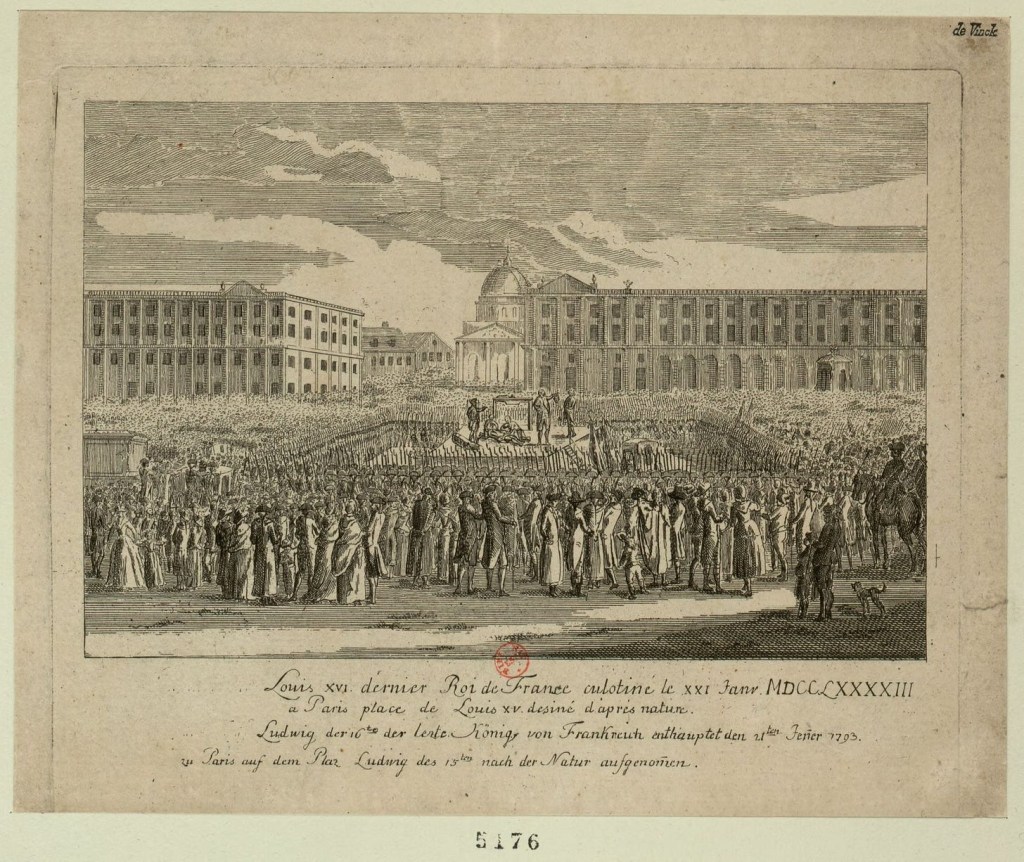
The author might have also remembered that in 1798, Napoleon’s troops had systematically looted wonderful works of art from every country he defeated, and brought them to Paris. Along with the Apollo Belvedere, the Laocoön, Raphael’s “Transfiguration”, the Horses of Saint Mark from Venice, were paraded through the city, behind a promise on a large banner:
After Waterloo, their fate changed more. Prussian diplomats threatened to have soldiers storm the Louvre and arrest its director if he didn’t hand over their paintings, the Flemish works were removed, and when the bronze horses were taken down from the Arc de Triomphe du Carrousel, the streets were lined by Austrian (decidedly non-bronze) cavalary. Shannon Selin notes: Touring the Louvre to see what remained, Louis XVIII reportedly remarked, “We are still rich”. That view was not generally shared by his subjects.
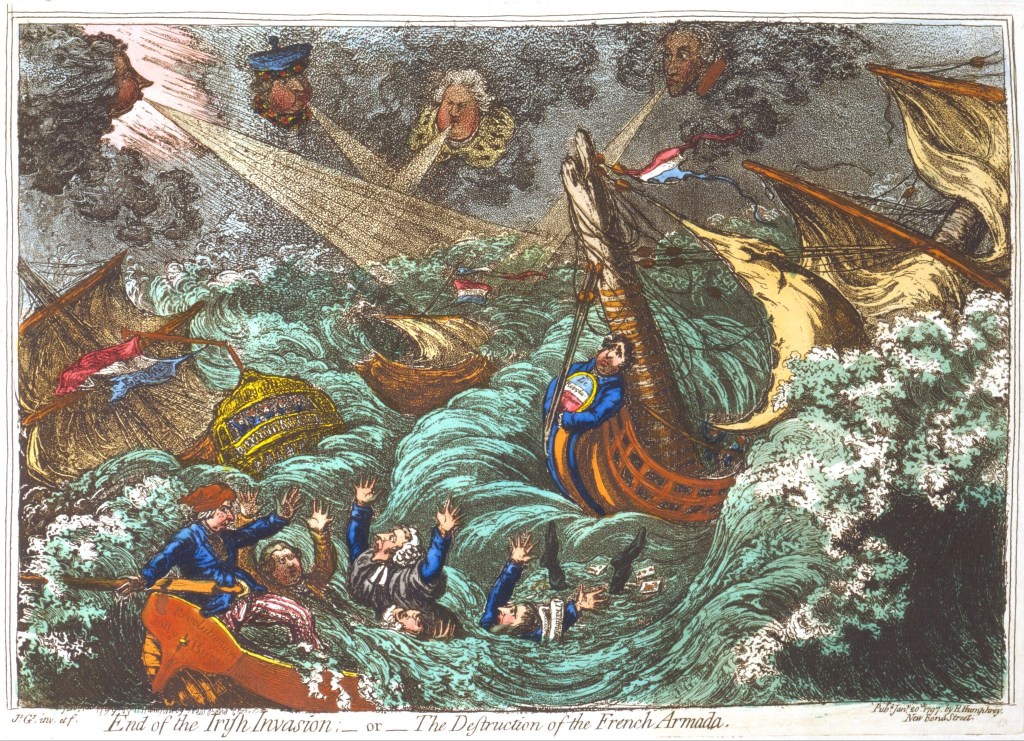
The second problem with with Williams’ argument is that the article is not, actually, the “origin” of the phrase.3 In 1797, Jacques Morgue published a book called “De la France, relativement à l’Angleterre et à la maison d’Autriche.” As I understand it, it’s a security strategy memo by a former minister of the interior, a case for what he explicitly calls a “révolution industrielle“. For context: By 1797, France had been at war with Britain for four years. On the continent, French armies could celebrate successes in Italy against Austria, Spain had switched sides to join France and the Dutch Republic had become a French client state. Britain, frustratingly, remained protected by the Channel and the Royal Navy. See, for example, the Bantry Bay expedition:
Meanwhile, British subsidies were sustaining continental coalitions, and British taxes – as Morgue argues- were being paid, in effect, by foreign consumers buying cheap english products. He proposes that France should deliberately operate an industrial revolution “at” their adversary, by competing with the English in every market, collapse the volume of their sales, and force them to bear the fiscal burden their export economy had been externalising onto the rest of the world. In short: Morgue proposes an industrial strategy for a revolutionary government as an act in a revolutionary war: What else was he supposed to call it?
Postscript: Who cares?
We don’t have to know what an art-critic from 1827 meant with the term “the industrial revolution” (and we can’t, really know). But whether “the impact of AI exceeds that of the industrial revolution” depends on what the we, currently, mean when we say that phrase. I think some people might not have asked themselves that question, because they think there is an objective definition somewhere, and they don’t want to be the only one not knowing “what collection of events” the industrial revolution contains.
I hope that it’s helpful to point out that the origin of the phrase (let alone it’s popular use!) arrives relatively late, and its somewhat chaotic and that any definition was shaped by a specific context. People alive between 1750 and 1850 didn’t see a great big sign in the sky saying “it’s the industrial revolution now, behave accordingly” (and if they did, noone would have known what that means). I forget about this, sometimes. Using only this “industrial revolution” analogy to think about future economic impacts of AI can easily make the future seem like the end of a story we’ve heard before. These stories can be seductively comforting: Industrial revolutions, we might feel, got us where we are now – that’s simply what they do. And the future will just be more of that path to where we already are.
Many people have written (well) about this problem. 4 What I’ve seen fewer people write about is that the “centrality of human choices”, and the contestation of what factors shaped them, is what makes the past and the present interesting. Those few people include Kenneth Burke, in “Attitudes towards History”, which I recommend reading, it’s very short. 5 Maybe it’s obvious. But it still seems worth saying, or showing. I think the large body of literature on the historiography of the industrial revolution (e.g. Tomory, 2016, Agnoletto, or Chapter 2 of Swain, 2020 for anyone watching the world cup) and the debate on the industrial revolution as a “memory-site” (e.g. Coleman, 1992 and O’Brien, 2004) do a great job at this. 6
- Twelve days before the article was published, the 7th French industry fair started. The author would have seen 600’000 visitors looking at new kinds of heavy machinery, a carpet made entirely of 4,000 Ostrich feathers, and apparently, a giraffe. (Arthur Chandler: A gift of the Pasha of Egypt, the Giraffe had been marched from Marseilles to Paris and arrived in Paris two months before the exposition opened.) ↩︎
- On average – and that’s only the official count. If we insist on counting those who died in prison or were killed without trial, the real number was potentially up to three times higher. ↩︎
- (Neither is the 1799 letter from Louis-Guilleaume Otto that Francois Crouzet cites as the “first known use of the phrase” in “the industrial revolution in national context: Europe and the USA” – notably without supplying a source.) ↩︎
- Worse: If the past, present and future are fixed, sectioned into objective “era’s”, where some activities are appropriate and others aren’t, people often stop taking personal and collective responsibility, and simply engage in “timely” activities. I’m pretty sure Robert McNamara tried to think that way sometimes, looking back on his work as Secretary of Defense during the Vietnam War. Asked by an interviewer in 2003 about whether his thinking on the war was affected by the large-scale protests, or Norman Morrison self-immolating in front of his office, he replies:
McNamara: I don’t think my thinking was changing. We were in the Cold War. And this was a Cold war activity. Many people have made this point, about the political problems of not engaging with history beyond singular, uncontestable and absolutist historical narratives. (Koselleck, 1985 or Y Gasset’s Man and Crisis. Acemoglu and Johnson engage in this contestation directly, when arguing for the “centrality of human choices” for the direction of technological change, in their paper on hand loom weavers. They say: “Recognizing the essential role of choice over the direction of technology and organizational forms is not only relevant for understanding the early decades of the Industrial Revolution; it is also critical to appreciate how and why things started changing from around 1850 onward.” (I wrote a tiny bit more about it here)). ↩︎ - He also wrote well about the false dichotomy between a rejection of the future the “sentimental acceptance” of one particular incipient futurist, who “seems to have forced himself to welcome developments that he did not really like. He saw the world going in a direction basically abhorrent to him—but his cult of optimism and historicism made him want to salute his times, to be a “yea-sayer,” and “answerer,” to make his peace with the Zeitgeist.” (Marinetti) “and his school would “abolish the cult of proportion” – they’ would be “drunk on life,” a life which they would eagerly depict by the metaphors of “revolution, war, shipwreck, earthquake” – they would stress verbs, since adjectives and adverbs were not strong- they would seek for analogies without the restrictions of good taste: “For instance, some people have compared an animal to man or to other animals, which is almost photography. Others, more advanced, might compare a foxterrier to a gun. But I compare it to boiling water.” They are for a “maximum of disorder”; a “lyric obsession with matter”; the abolition of sentiment; for the “telegraphic,” the “vibratory,” the “cult of speed, the new.” For the ugly, the “reign of machinery,” “imagination unchained,” the glorification of industrial and financial nationalism. They are “against the harmonious,” against “moonlight, reminiscence, nostalgia, eternity, immortality.” ↩︎
- And so do Blogposts! On the industrial revolution, see also: https://substack.com/@larathurnherr/note/c-262049279 ↩︎


Leave a Reply