Acemoglu and Johnson, in a paper on hand loom weavers’ wages in the early 19th century say:
“Recognizing the essential role of choice over the direction of technology and organizational forms is not only relevant for understanding the early decades of the Industrial Revolution; it is also critical to appreciate how and why things started changing from around 1850 onward.”
They argue that decisions on the direction of technology and organisational forms, like the 1835 parliamentary commission on hand-loom weavers decision to write a report about the poor conditions of people in the age of the power loom, have meaningfully influenced the impact of the industrial revolution.
To add to their point – it might be interesting to know that another commission, launched in 1837, published a different report in 1841, and it had a slightly different tone than the one from 1835. While the report from 1835 talks about the “causes and results of distress”, and the ways that distress could be minimised, the report from 1841 is structured into an analysis of the causes for low demand and high supply of labour. The difference in perspective is also visible in the prioritised “remedies” the commissions come up with.
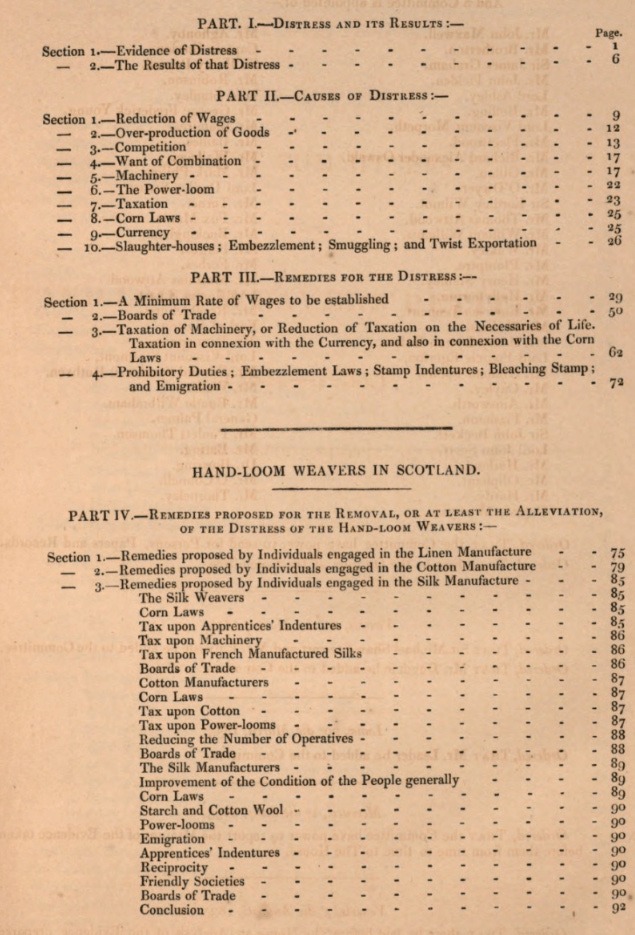
Remedies proposed by the 1835 Hand Loom Commission, chaired by Sir John Maxwell
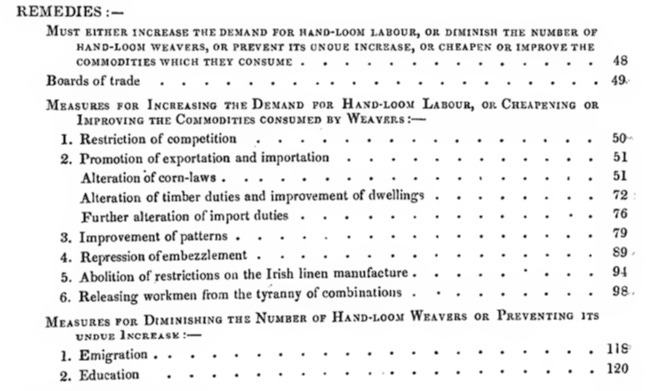
Remedies proposed by the 1841 Hand Loom Commission, chaired by Nassau William Senior
While the first commissions’ report recommends a minimum wage and taxes, the second commission is more interested in “releasing workmen from the tyranny of combinations” (Unions) . While the “remedy” of emigration plays a relatively minor role in the first report, the second one calls it the most “obvious” means for “remedying the distress of the hand-loom weavers by either diminishing their number or preventing its undue increase.”


Leave a Reply